Multisensory
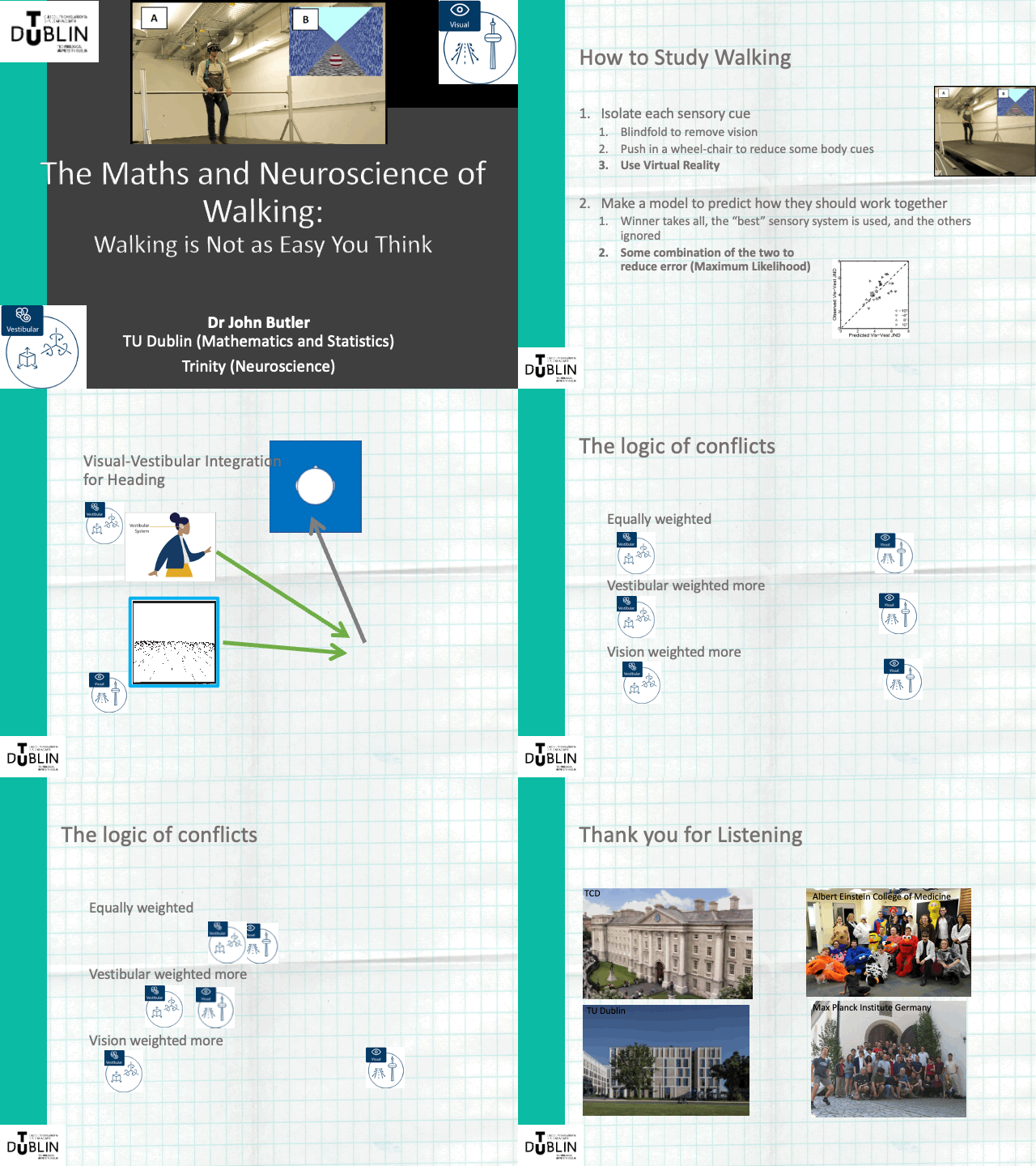
This workshop dives into the maths and neuroscience behind how we combine our multiple senses, such as sight and balance, for walking or even make a quick escape from bears!
This workshop links neuroscience and maths to show how the brain combines information from vision, balance, and other senses to guide behaviour, from walking steadily to reacting quickly in dangerous situations, like escaping a bear 🐻.
Through examples drawn from virtual-reality experiments, students see how mathematical models can predict the way the brain weights sensory inputs to reduce error and improve movement accuracy.
It’s an accessible introduction to modelling and data interpretation that connects classroom maths to real-world applications in neuroscience and technology.
The brain uses a combination of sensory inputs, visual (sight), auditory (sound), proprioception (muscles and joints), and vestibular (velocity and acceleration), to perceive self-motion. The box on the lower right shows the location of the vestibular system, which is found in the inner ear (Campos et al 2020).
Materials
Lesson Plan and Slides.
Handouts
Worksheets and MCQs
Curriculum Aligment
Primary and Secondary
Irish curriculum alignment
The Multisensory Integration workshop explores how the brain combines information from multiple senses — such as sight, balance, and touch — to produce a single, more accurate estimate of what is happening in the world. The core mathematical idea is the weighted average: the brain gives more weight to whichever sense is most reliable in a given situation, and by combining signals in this way it outperforms any single sense alone.
| Subject | Primary | Junior Cycle | Leaving Cert |
|---|---|---|---|
| Mathematics | Data and Chance | Statistics and Probability; Numbers | Statistics and Probability |
| Science | Human Body | Biological World | Biology — Nervous System and The Senses |
| Measures | Measures | — | — |
| Applied Mathematics | — | — | Mathematical Modelling |
| PE / Physical Education | — | body awareness, balance, and coordination | understanding the role of sensory feedback |
| SPHE | understanding how my body works | — | — |
Materials
| Multisensory Teacher Lesson Plan | Multisensory Slides |
Handouts
Start here — includes timing, learning objectives and preparation notes.
| Handout | Solution |
|---|---|
| Multisensory Worksheet | Solution |
| Multisensory MCQ | Solutions |
Certificate of Completion
The material is released under CC-BY-NC. Feel free to share and adapt them.
Contact
Have a question about the workshops, want to arrange a session for your school, or have feedback to share?
- 📧 Dr John Butler — john.butler@tudublin.ie
We'd love to hear how the workshops went:
| Student Feedback Form | Teacher Feedback Form |
References
Campos, J. L., Pandi, M., & Butler, J. S. (2020). “Feeling” Ourselves Move: A Team Effort by Our Senses. Frontiers for Young Minds, 8(9). DOI: https://doi.org/10.3389/frym.2020.00009 PDF