Decision Making
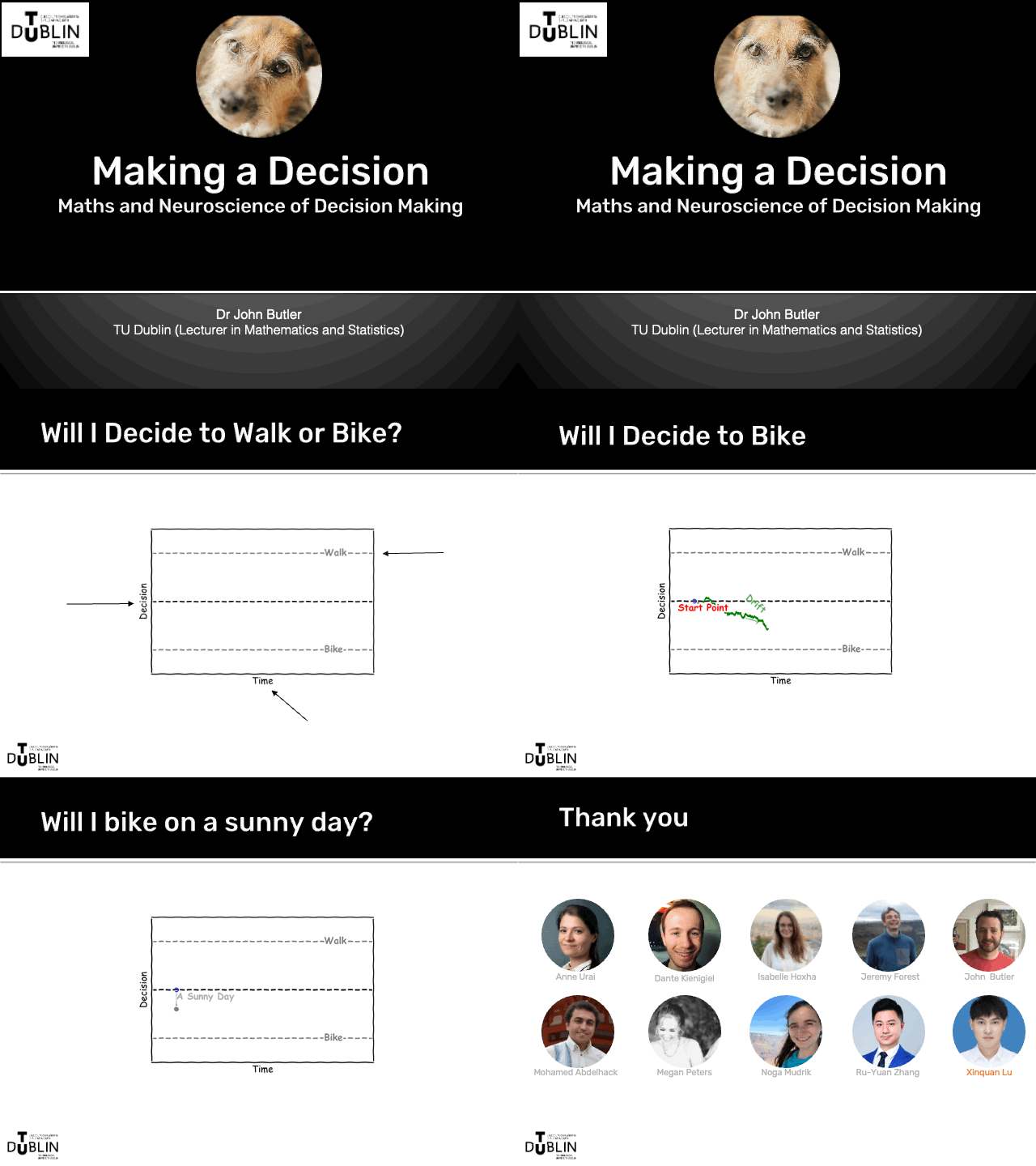
This workshop shows how making simple decisions can be modelled and predicted using maths. The same formula has been used to model a particle moving in space.
The workshop blends neuroscience with mathematical modelling to explore how the brain gathers evidence, handles uncertainty, and responds to time pressure when making choices.
Using an example students can relate to, “Should I walk or cycle to school?” they learn how concepts like drift, noise, and evidence accumulation are used to model decisions in both everyday life and scientific research.
It links the maths model to real brain processes and encourages students to see decision-making as a dynamic, measurable phenomenon.
Materials
Lesson Plan and Slides.
Handouts
Worksheets and MCQs
Curriculum Aligment
Primary and Secondary
Irish curriculum alignment
The Decision Making workshop explores how the brain reaches a conclusion under uncertainty, using a mathematical framework called the drift-diffusion model. Rather than deciding instantly, the brain accumulates noisy evidence over time until it crosses a threshold — and the workshop shows how adjusting that threshold creates a fundamental trade-off between speed and accuracy.
| Subject | Primary | Junior Cycle | Leaving Cert |
|---|---|---|---|
| Mathematics | Data and Chance | Statistics and Probability | Statistics and Probability |
| Science | Working Scientifically | Nature of Science | Biology — Nervous System |
| Applied Mathematics | — | — | Mathematical Modelling |
| Business Studies | — | hhow businesses and individuals make decisions under uncertainty | — |
| SPHE / CSPE | Making decisions | Critical thinking | — |
| PE / Physical Education | — | reaction time and decision making in sport | L tactical decision making under pressure |
Materials
Start here — includes timing, learning objectives and preparation notes.
| Decision Making Slides | Decision Making Teacher Lesson Plan |
Handouts
| Handout | Solution |
|---|---|
| Decision Making Worksheet | Solutions |
| Decision Making MCQ | Solutions |
Certificate of Completion
This workshop was originally created for Neuromatch for Kids, and a more adult-friendly version (written with Rebecca Brady) appears on RTÉ Brainstorm, exploring the maths behind another everyday decision: “Should I have another pint or go home?”
The material is released under CC-BY-NC. Feel free to share and adapt them.
Contact
Have a question about the workshops, want to arrange a session for your school, or have feedback to share?
- 📧 Dr John Butler — john.butler@tudublin.ie
We'd love to hear how the workshops went:
| Student Feedback Form | Teacher Feedback Form |
References
Hoxha, I., Mudrik, N., Urai, A. E., Kienigiel, D., Forest, J., Abdelhack, M., Peters, M., Halper, N., Zhang, R.-Y., Lu, X., & Butler, J. S. (2023, August 24–27). Opening Computational Neuroscience to a Wider Audience: Virtual Escape Room for Kids [Poster presentation]. Conference on Cognitive Computational Neuroscience, Oxford, United Kingdom. https://doi.org/10.32470/CCN.2023.1197-0